
- Colección Salud-Textos
Vaginal Delivery, as the Obstetrician Would Say
- Editado por: Wilmar Saldarriaga Gil
- Autor: Wilmar Saldarriaga Gil
- Autor: Hoover Orlando Canaval Erazo
- Autor: Javier Enrique Fonseca Pérez
Descripción›
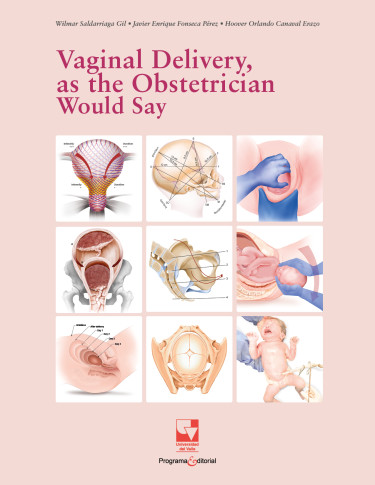
This book aims to describe in-depth decisions about maternal care with up-to-date and practical knowledge that improves obstetric and perinatal outcomes of the mother-baby binomial. Developed in seven chapters, with dozens of figures, it begins by describing the physiological, hormonal, immunological, and enzymatic events produced in mother-fetus communication between the onset of regular uterine contractions, through labor, birth, and delivery, until the puerperium. In this context, the Friedman curve and the new studies and definitions established by Dr. Zhang and his group are compared. It is explained how the partograph must be filled out properly, relating to the alterations of labor known as dystocia, and recommendations are given for timely diagnosis and relevant interventions. A chapter on electronic fetal monitoring is included, emphasizing antepartum and intrapartum interpretation and its clinical utility. Multiple examples are presented with recording graphs and correlated with fetal acid-base status. Postpartum hemorrhage is addressed. It is a foreseeable event secondary to childbirth, whose mortality is almost always avoidable. For this reason the authors develop the topic including pathophysiology, etiology, risk factors, prevention, diagnosis, and diagnostic aids, medical and surgical interventions according to the cause. For the authors, this book could not fail to include a chapter on labor induction. Bearing in mind that a properly carried out practice can reduce the number of cesarean sections and maternal and fetal morbidity and mortality, the indications, contraindications, risks, and different methods to end the pregnancy by vaginal delivery are presented. The last chapter deals with the normal puerperium and the pathologies frequently found in women after childbirth and ends with the protocol of the postpartum control appointment. This book has been created after the simple observation of three professors from the Universidad del Valle who, from their day-to-day work, mainly at the Hospital Universitario del Valle “Evaristo García,” concluded that students and professionals from different health careers involved in maternal care could improve their knowledge regarding labor, delivery and the puerperium; and that although there are texts available in the literature on obstetrics in general, and that most of them are of good academic quality, none of them is dedicated exclusively to addressing physiological processes and their alterations during labor, delivery, and the puerperium as in the book Vaginal Delivery, as the Obstetrician Would Say.
Tipo de Contenido›
Contenido
Chapter 1.
Labor, Delivery and Partograph —— 11
Wilmar Saldarriaga Gil, Javier E. Fonseca Pérez, Hoover O. Canaval Erazo
Physiology of Labor and Delivery . . . . . . . . . . . . . . . . 11
Physiological Phases of Labor . . . . . . . . . . . . . . . . . . 12
Uterine activity . . . . . . . . . . . . . . . . . . . . . . . . . 17
Alterations in the uterine dynamics . . . . . . . . . . . . . . . 19
False labor . . . . . . . . . . . . . . . . . . . . . . . . . . . . 19
Labor development . . . . . . . . . . . . . . . . . . . . . . . 20
First stage of labor: cervical dilation . . . . . . . . . . . . . . . 21
Second Stage of Labor: Expulsion Stage . . . . . . . . . . . . . 25
Third Stage of Labor: Delivery of the Placenta . . . . . . . . . 25
Placenta . . . . . . . . . . . . . . . . . . . . . . . . . . . . . 26
Recommendations for integral care of pregnant individuals
during labor . . . . . . . . . . . . . . . . . . . . . . . . . . . 27
Partograph . . . . . . . . . . . . . . . . . . . . . . . . . . . 33
How to use the CLAP partograph . . . . . . . . . . . . . . . . 35
Chapter 2.
Labor Abnormalities. Labor Dystocias —— 45
Wilmar Saldarriaga Gil, Javier E. Fonseca Pérez, Hoover O. Canaval Erazo
Considerations and Management . . . . . . . . . . . . . . . . 45
Classification of Dystocias . . . . . . . . . . . . . . . . . . . . 50
Chapter 3.
Electronic Fetal Monitoring or Cardiotocography —— 65
Javier E. Fonseca Pérez, Wilmar Saldarriaga Gil, Hoover O. Canaval Erazo
Definitions in Cardiotocography . . . . . . . . . . . . . . . . 66
Antepartum Electronic Fetal Monitoring . . . . . . . . . . . . 72
Intrapartum Electronic Fetal Monitoring . . . . . . . . . . . . 76
Chapter 4.
Mechanisms of Labor —— 89
Javier E. Fonseca Pérez, Wilmar Saldarriaga Gil, Hoover O. Canaval Erazo
Fetal Positioning . . . . . . . . . . . . . . . . . . . . . . . . . 89
Fetal Diameters . . . . . . . . . . . . . . . . . . . . . . . . . 95
Maternal Pelvis . . . . . . . . . . . . . . . . . . . . . . . . . 97
Mechanism of Labor in Vertex Modality . . . . . . . . . . . . 100
Maneuvers in Delivery Care . . . . . . . . . . . . . . . . . . 107
Episiotomy . . . . . . . . . . . . . . . . . . . . . . . . . . . 109
Indications for Episiotomy . . . . . . . . . . . . . . . . . . . 109
Procedure . . . . . . . . . . . . . . . . . . . . . . . . . . . 111
Analgesia and Anesthesia . . . . . . . . . . . . . . . . . . . . 112
The Incision and its Orientation . . . . . . . . . . . . . . . . 112
Anatomical Planes Involved in Episiotomy . . . . . . . . . . . 113
Repair of Episiotomy or Perineal Laceration . . . . . . . . . . 115
General Recommendations for Episiorrhaphy . . . . . . . . . 115
Continuous Suture in Three Planes . . . . . . . . . . . . . . . 116
Non-continuous or Interrupted Suture . . . . . . . . . . . . . 117
Chapter 5.
Postpartum Hemorrhage —— 119
Wilmar Saldarriaga Gil, Javier E. Fonseca Pérez, Hoover O. Canaval Erazo
Magnitude of the Problem . . . . . . . . . . . . . . . . . . . 119
Definition . . . . . . . . . . . . . . . . . . . . . . . . . . . 119
Physiopathology . . . . . . . . . . . . . . . . . . . . . . . . 120
Etiology and Risk Factors . . . . . . . . . . . . . . . . . . . 121
Diagnosis . . . . . . . . . . . . . . . . . . . . . . . . . . . . 124
Prevention . . . . . . . . . . . . . . . . . . . . . . . . . . . 124
Treatment . . . . . . . . . . . . . . . . . . . . . . . . . . . 128
Identification of the Cause and Control of Bleeding . . . . . . 136
Chapter 6.
Cervical Ripening, Augmentation and Induction of Labor —— 155
Hoover O. Canaval Erazo, Wilmar Saldarriaga Gil, Javier E. Fonseca Pérez
Indications for Termination of Pregnancy . . . . . . . . . . . 155
Definitions . . . . . . . . . . . . . . . . . . . . . . . . . . . 158
Traditional or Empirical/Popular Methods . . . . . . . . . . . 159
Evaluation of the Cervix Prior to Determining an Induction
or Augmentation of Labor . . . . . . . . . . . . . . . . . . . 160
Pharmacological Methods for Cervical Ripening . . . . . . . . 161
Pharmacological Methods for Induction and Augmentation
of Labor . . . . . . . . . . . . . . . . . . . . . . . . . . . . 174
Chapter 7.
Normal Puerperium and Frequent Pathologies —— 189
Hoover O. Canaval Erazo, Wilmar Saldarriaga Gil, Javier E. Fonseca Pérez
Physiological Adaptations in the Puerperium . . . . . . . . . . 189
Clinical Surveillance in the Immediate Puerperium . . . . . . . 198
Contraception During the Puerperium . . . . . . . . . . . . . 201
Pathological Puerperium . . . . . . . . . . . . . . . . . . . . 204
Puerperal Infections . . . . . . . . . . . . . . . . . . . . . . 204
Postpartum Control Appointment Protocol . . . . . . . . . . 217
Glossary —— 223
Analytical index —— 233
Clasificación temática›
- MED033000MEDICINA > Ginecología y Obstetricia(Principal)
- MKCGinecología y obstetricia(Principal)
- 618.2Tecnología (ciencias aplicadas) > Ciencias médicas y medicina > Ginecología y otras especialidades médicas > Obstetricia(Principal)
- Gynecology and obstetrics
Palabras clave›
- Childbirth
- Obstetrics
- Postpartum
- Labor
Especificaciones por formato:
ISBN-13: 9789585073494
DOI: 10.25100/peu.839
Idioma del texto: Inglés
Número de edición: 1
País de publicación: Colombia
Año de publicación: 2025
Número absoluto de páginas: 240 páginas
ISBN-13: 9789585073500
DOI: 10.25100/peu.839
Idioma del texto: Inglés
Número de edición: 1
País de publicación: Colombia
Año de publicación: 2025
Número absoluto de páginas: 240 páginas
Disponibilidad en otros canales⌄
Libro electrónico (PDF)Catálogo Programa Editorial UnivalleLibro electrónico (EPUB)Catálogo Programa Editorial Univalle
Ayuda
Información general
Atención al cliente
¿Requieres ayuda adicional? Si tienes dudas o consultas sobre tu pedido o requieres información adicional en nuestro Portal Ulibros, comunícate con nuestro personal de Soporte al cliente:
[email protected] +57 3208500513