
- Colección Textos
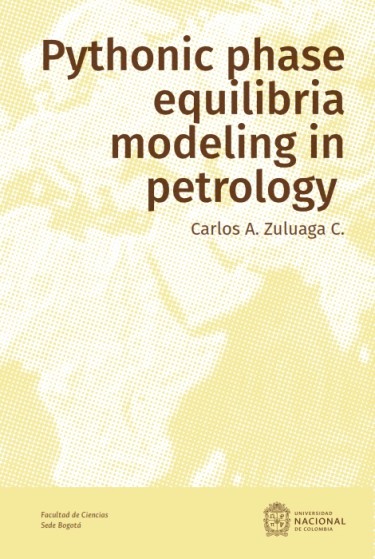
Pythonic phase equilibria modeling in petrology
Descripción›
This book is an introduction to the algorithms used on geological phase equilibria modeling following the current trend in the petrological community to estimate P − T conditions for the formation and evolution of rocks. The text is intended for gaining understanding of thermodynamic modeling applied to petrology, especially in the estimation of equilibrium conditions for rocks in the lithosphere. The approach used within the book follows the application of phase equilibria concepts to some practical aspects of modeling. The book starts with a brief introduction to Python programming and the bases of linear algebra, then, it introduces the thermodynamic theoretical framework along with the basis of phase equilibria. The last two chapters present details of thermobarometric calculations and phase diagram modeling.
Tipo de Contenido›
List of Figures 9
List of Tables 11
Acknowledgements 13
Preface 15
Chapter 1 – Introduction 1
1.1 Programming Tool: Python 3
1.2 Jupyter Notebooks 4
1.2.1 The Cells of the Notebook 4
1.3 Algorithms 6
1.4 Some Fundamental Programming Concepts in Python 8
1.4.1 Variables and Constants 8
1.4.2 Control Instructions – Loops 8
1.4.3 Control Instructions – Conditional or Alternative 8
1.4.4 Functions 9
1.5 Data Types in Python 11
1.6 Linear Algebra and Python for Scientific Purposes I 12
1.6.1 NumPy 12
1.6.2 Vectors 12
1.6.3 Inner (Dot) Product 13
1.6.4 Span of a Set of Vectors and Linear Independence 13
1.6.5 Matrices 14
1.6.6 Block Matrices and Submatrices 15
1.6.7 Matrix Transpose 16
1.6.8 Matrix–Matrix Multiplication 16
1.6.9 Inverse of a Matrix 17
1.6.10 The Determinant of a Matrix 17
1.6.11 The Rank of a Matrix 20
1.6.12 The Null Space of a Matrix 21
1.6.13 Summary of Tests for Singularity 21
1.6.14 Solution of Linear Systems 22
1.6.15 Transformations 23
1.6.16 Decompositions 26
1.6.17 Some Useful NumPy Functions 31
1.7 Python for Scientific Purposes II 32
1.7.1 Matplotlib 32
1.7.2 SciPy 33
1.7.3 Optimization 34
Chapter 2 – Four Laws 39
2.1 The Zeroth Law 41
2.2 The First Law 44
2.3 Molar Heat Capacity 45
2.4 The Second Law 46
2.5 The Third Law 47
2.6 Thermodynamic Potentials 47
2.6.1 Legendre Transform 48
2.7 Enthalpy 50
2.8 Heat Capacity at Constant Pressure 51
2.9 Standard Enthalpy of Formation 51
2.10 Gibbs Free Energy 51
2.11 Behavior of Specific Heat Functions (Molar Heat Capacity) 52
2.12 Thermodynamic Datasets 57
2.13 A Dataset Reader 58
Chapter 3 – Compositional and Reactive Spaces 63
3.1 Compositional Space 65
3.1.1 Definition of Components 65
3.1.2 Components of a Phase 65
3.1.3 Component Transformations 66
3.1.4 Applications 67
3.2 Reactive Space 72
3.2.1 Geometric Analysis 72
3.2.2 Number of Invariant Points and Univariant Reactions 72
3.2.3 Number of Components 74
3.2.4 Combinatorics of the Phases and Possible Reactions 75
3.2.5 Calculation of Independent Reactions 76
3.2.6 Derivation of All Possible Reactions 76
3.2.7 Schreinemakers 79
3.2.8 Summary of Chemographic Analysis in Triangular Diagrams 88
Chapter 4 – Phase Equilibria in Systems with Pure Phases 91
4.1 Gibbs Free Energy (G) 93
4.1.1 Gibbs Free Energy of Formation at the Reference State 93
4.1.2 Gibbs Free Energy Change in a Reaction 93
4.1.3 Reaction Curves 94
4.2 Equations of State (EOS) 97
4.2.1 EOS for Gases 98
4.2.2 EOS for Solid Phases 101
4.2.3 EOS for Melts 103
4.2.4 Gibbs Free Energy and EOS for Aqueous Solutions 103
4.3 Gibbs Free Energy of Ordering (Pure Phases) 105
4.3.1 Landau 106
4.3.2 Bragg–Williams 108
4.3.3 Finding Q in the Bragg–Williams Model 110
4.4 Gibbs Free Energy Calculator for Solid Phases 112
4.5 Univariant Curves 114
4.6 Gibbs Energy Minimization for Systems with Pure Phases 117
Chapter 5 – Phase Equilibria in Systems with Solid Solutions 123
5.1 Partial Molar Properties, Chemical Potential, and Darken’s Equation 125
5.2 The Chemical Potential and the Gibbs Free Energy Equation in Multicomponent Phases (Solid Solutions) 126
5.3 The Gibbs–Duhem Equation 127
5.4 Raoult’s Law and Henry’s Law 127
5.5 Fugacity and Activity 130
5.6 Standard States 131
5.7 Ideal Solid Solutions 134
5.7.1 Molar Properties in Ideal Mixtures 134
5.7.2 The Entropy of Mixing and Activities in Ideal Mixtures 134
5.8 A Python Class for Ideal Solid Solution Models 141
5.8.1 The init() Function 141
5.9 Gibbs Free Energy of Non-Ideal Mixtures 143
5.10 Darken’s Quadratic Formalism 145
5.11 The Non-Ideal Class for Solid Solutions 145
5.12 Non-Ideal Mixtures with Ordered Endmembers 148
5.12.1 Final Note About the Solid Solution Class Code 150
Chapter 6 – Computation of Phase Diagrams 155
6.1 Introduction 157
6.2 GX Diagrams and Compatibility Diagrams 157
6.3 TX Diagrams 160
6.4 Computation 160
6.5 Phase Diagrams for Complex Systems 161
6.5.1 Gibbs Free Energy Minimization 163
6.5.2 Construction of Phase Diagrams Using a System of Nonlinear Equations 179
Chapter 7 – Thermobarometry 197
7.1 Basic Equations 200
7.2 Phase Equilibria Thermobarometry 203
7.2.1 Traditional Reaction Thermobarometry 203
7.2.2 Multiple Reaction Thermobarometry 204
7.2.3 Relative Thermobarometry 205
7.2.4 Phase Diagram Thermobarometry 205
7.3 Calibration of Traditional Reaction Thermobarometry 206
7.3.1 Univariate Robust Regression with Outlier Detection in Python 208
7.4 Error Propagation in the Gibbs Free Energy Equation 212
7.4.1 Error Propagation from Uncertainties in ΔH⁰fG in Endmember Reactions 213
7.4.2 Error Propagation from Uncertainties in Activities to ΔrG in Endmember Reactions 213
7.4.3 Calculation of Uncertainties in Activities 214
7.4.4 Putting It All Together 227
7.5 Pressure and Temperature of Intersection of Reactions with Error Estimates 232
7.5.1 Error Propagation to Estimates of Pressure and Temperature 232
7.5.2 Error Propagation for Pressure and Temperature Intersection of Reactions 234
Appendix A – Code Listing 249
References 293
Index 307
Clasificación temática›
- COM014000ORDENADORES > Ciencias de la Computación(Principal)
- UYCiencias de la computación(Principal)
- 005.1Generalidades > Generalidades y ciencias de la computación > Programación de computadoras, programas, datos > Programación(Principal)
- Ciencias
- Matemáticas
Palabras clave›
- modelado de equilibrio de fases
- petrología
- geología
- algoritmos
- condiciones P-T
- formación de minerales
- termodinámica
- modelado computacional
Especificaciones por formato:
ISBN-13: 9789585059528
Idioma del texto: Español
Tamaño: 17 x 24 x 3.0 cm
Peso: 0.31 kg
Número de edición: 1
País de publicación: Colombia
Año de publicación: 2025
Número absoluto de páginas: 309 páginas
Disponibilidad en otros canales⌄
ImpresoPortal de libros UNAL
Ayuda
Información general
Atención al cliente
¿Requieres ayuda adicional? Si tienes dudas o consultas sobre tu pedido o requieres información adicional en nuestro Portal Ulibros, comunícate con nuestro personal de Soporte al cliente:
[email protected] +57 3208500513